On 8 October, the FSA published a recall notice (FSA-PRIN-48-2026) for five ready-to-eat products which were sold through Tesco and M&S, after Salmonella was found in the pistachio nuts used as an ingredient in these products. Two Pinch meals sold exclusively at Tesco went, along with three M&S lines: a nutty wholefood salad with soy and ginger dressing, a nutrient-dense nutty wholefood pot, and a pistachio pesto from the Fresh Collection. Use-by dates ran from 10 to 13 October.
The FSA's advice was the standard line for Salmonella — don't eat it, and if you've got symptoms, stay off work or out of school until 48 hours after they clear. Tesco and M&S moved fast: all five lines were pulled within a day or two of the issue surfacing, and both retailers are taking returns without a receipt.
M&S called it precautionary, which in practice usually means the business acted on a positive test or a strong trace-back before anyone got ill, rather than waiting for confirmed cases. That's the right call, and it's worth noticing when a recall goes that way.
The bit that should interest anyone running a food safety system is what the ingredient actually was. Pistachios aren't a new risk — Salmonella in tree nuts, and pistachios specifically, has shown up repeatedly over the last few years in outbreaks traced back to orchards and processing in the supply chain, not to the UK businesses using them.
The nuts arrive as a raw material that gets folded into salads, pestos and wholefood pots with a potential heat treatment prior to arriving on a food manufacturing site. But no cook step afterwards. That's the crux of it: once a nut goes into a ready-to-eat product and there is no lethality step downstream, whatever's on it when it arrives is what the customer eats.
If you're buying nuts, seeds, dried herbs, or any other ready-to-eat ingredient with a known pathogen history, your supplier approval file needs to earn its keep, not just exist. A certificate of analysis from the supplier is a starting point, not a control. What you want to see is evidence the supplier is testing for the pathogens relevant to that commodity, at a frequency that makes sense given the history, and that you've got your own verification sitting on top — incoming testing, or at minimum a documented rationale for why you're relying on the supplier's data instead.
Your HACCP or food safety plan should flag these ingredients explicitly in the hazard analysis, not bury them in a generic "raw materials" line, and your TACCP/VACCP work should ask the obvious question: is there a kill step anywhere downstream of this ingredient, and if not, what's actually controlling the hazard?
Why it matters: Salmonella survives for months in low-moisture nuts. Pistachios have a real outbreak history, including the 2016 US Salmonella Montevideo recall and the 2025 US outbreak linked to pistachio cream used in “Dubai chocolate” style products.
What I’d check on audit
Specification (BRCGS clause 3.6): does it state whether the nuts are pasteurised or untreated, and by what method?
Supplier approval (BRCGS clause 3.5.1): for a pasteurised claim, ask for the supplier’s process validation, not just a CoA.
CoAs (BRCGS 3.5.2.1 / 3.5.1.1): Salmonella absent in 25g and aflatoxin results. Remember a negative CoA isn’t a control for a low-level, non-homogeneous contaminant.
HACCP (BRCGS 2): if the site uses untreated nuts in an RTE product with no downstream cook, Salmonella from the nuts should be a significant hazard. There needs to be a clear control, such as buying only pasteurised nuts or treating them on site. If neither exists, that’s a likely non-conformity.
Raw material risk assessment: understanding the product
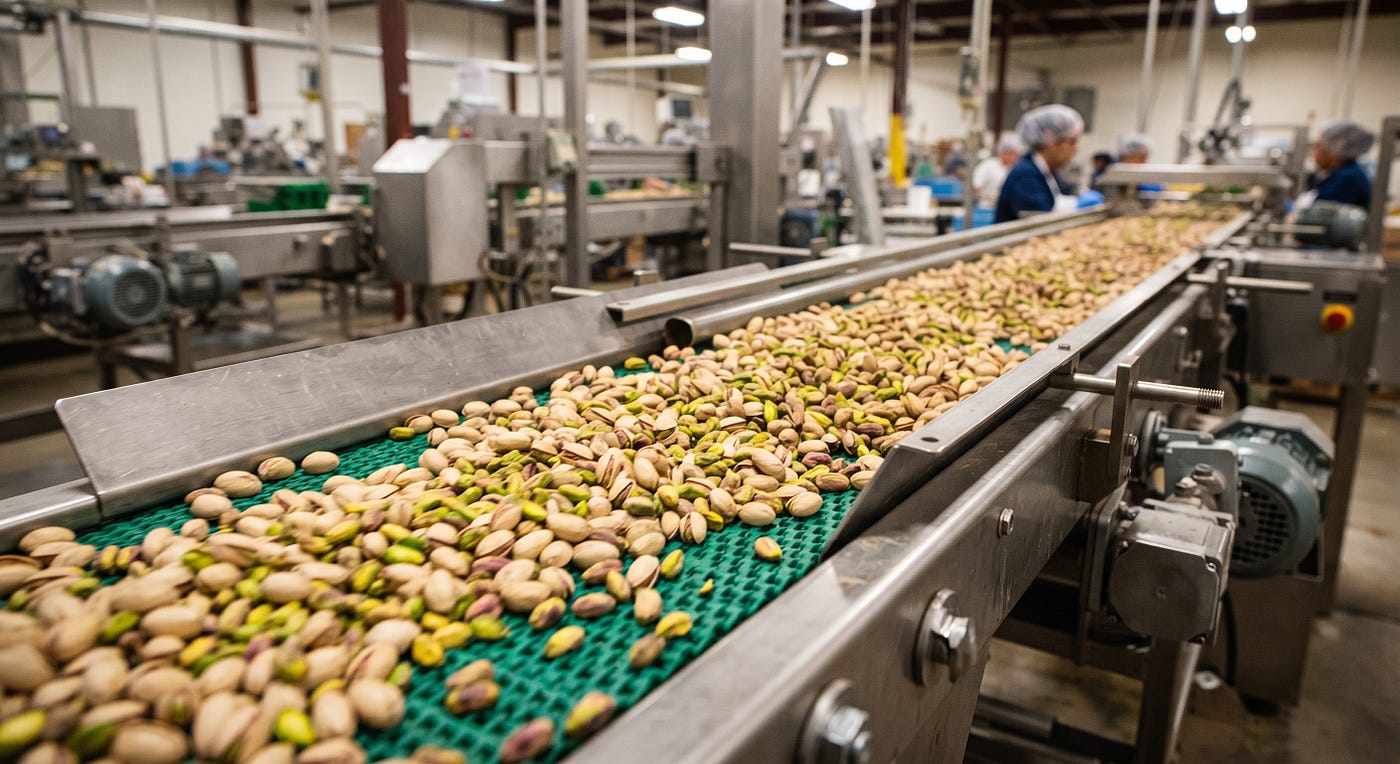
Immediately after harvesting and hulling, pistachios have a moisture content of around 35% to 40%. Within 24 hours, they must be dried down to 5% to 7% moisture using forced heated air (typically between 60°C and 82°C for several hours) primarily to prevent mould growth and aflatoxin production.
Food safety status: although this is a heat process, commercial hulling and drying are not typically validated as a microbial lethality step (CCP). Furthermore, the nuts are held in bulk storage silos and graded/sorted after drying, meaning they remain vulnerable to post-drying environmental cross-contamination (especially Salmonella).
Pistachios marketed as “raw” RTE vs. roasted RTE
When pistachios are supplied into a manufacturing facility as an RTE ingredient (e.g., for inclusions in chocolate, bakery toppers, snack mixes, or ice cream), how they were processed depends on the specification:
Dry or oil roasted: hot air convection or continuous oil roaster (120°C–160°C for 10–25 mins).
Steam / vacuum pasteurised ("raw" RTE): pressurised steam or vacuum-assisted moist heat (75°C–95°C short hold) followed by drying.
Non-thermal pasteurised ("raw" RTE): propylene oxide (PPO) fumigation (common in the US, prohibited in the EU/UK) or irradiation.
Untreated "raw" kernels: post-harvest drying only (60°C–82°C) — no pathogenic kill step.
Why validation matters for RTE use
Salmonella exhibits extreme thermal resistance in low-water-activity (aw < 0.60) and high-fat environments like tree nuts. Standard dry heat requires significantly higher temperatures and longer dwell times to achieve a 4- to 5-log reduction compared to moist heat (steam). If you are evaluating pistachios as an RTE ingredient or inclusion where there is no further kill-step in your own process (e.g., dusting onto finished confectionery, cold-pressed bars, or cold desserts):
Never assume “dried” means “pasteurized”: Untreated raw kernels have only gone through post-harvest drying and sorting.
Require a Certificate of Pasteurization / Kill-Step Validation: If purchasing “raw” green kernels for RTE application, the supplier must confirm they have undergone a validated steam/vacuum pasteurization process (typically achieving a minimum 4-log or 5-log reduction in Salmonella using a validated surrogate like Enterococcus faecium NRRL B-2354).
Crisis management and product recall (BRCGS clause 3.11)
The other thing worth checking against your own systems is recall speed. Five SKUs, two retailers, pulled within roughly a day of the issue being identified — that's traceability, mass balance on the raw material used and mock recall testing working as intended. If you did a mock recall tomorrow and it took longer than that to identify every batch, every customer, and every location a flagged ingredient had gone into, that's your gap to close before it's a live one.